
How to Read a Posting's Actual Tier
Senior postings are up 14.7%. Only 12% of experienced applications go there. Here's how to calibrate before you apply.
Senior-level postings on Indeed rose 14.7% year-over-year as of May 2026. Mid-level fell 6.7%. The market is explicitly moving up-tier.
Candidates with 10+ years of experience sent 12% of their applications to senior roles. Eighty-eight percent went to mid-level and below.
You’ve solved the spray problem. You’re targeting. The gap now is something more specific: tier calibration. Posting titles lie. Screening criteria tell the truth. And plenty of candidates who do apply to senior roles get read one level below where they applied.
Here’s how to close that gap.
How postings misrepresent their tier
Companies title roles inconsistently. “Senior Manager” at one company is “Director” at another. “Lead” is sometimes IC, sometimes a people manager. The title alone doesn’t tell you what the role actually screens for.
What does tell you: the verb tier in the requirements.
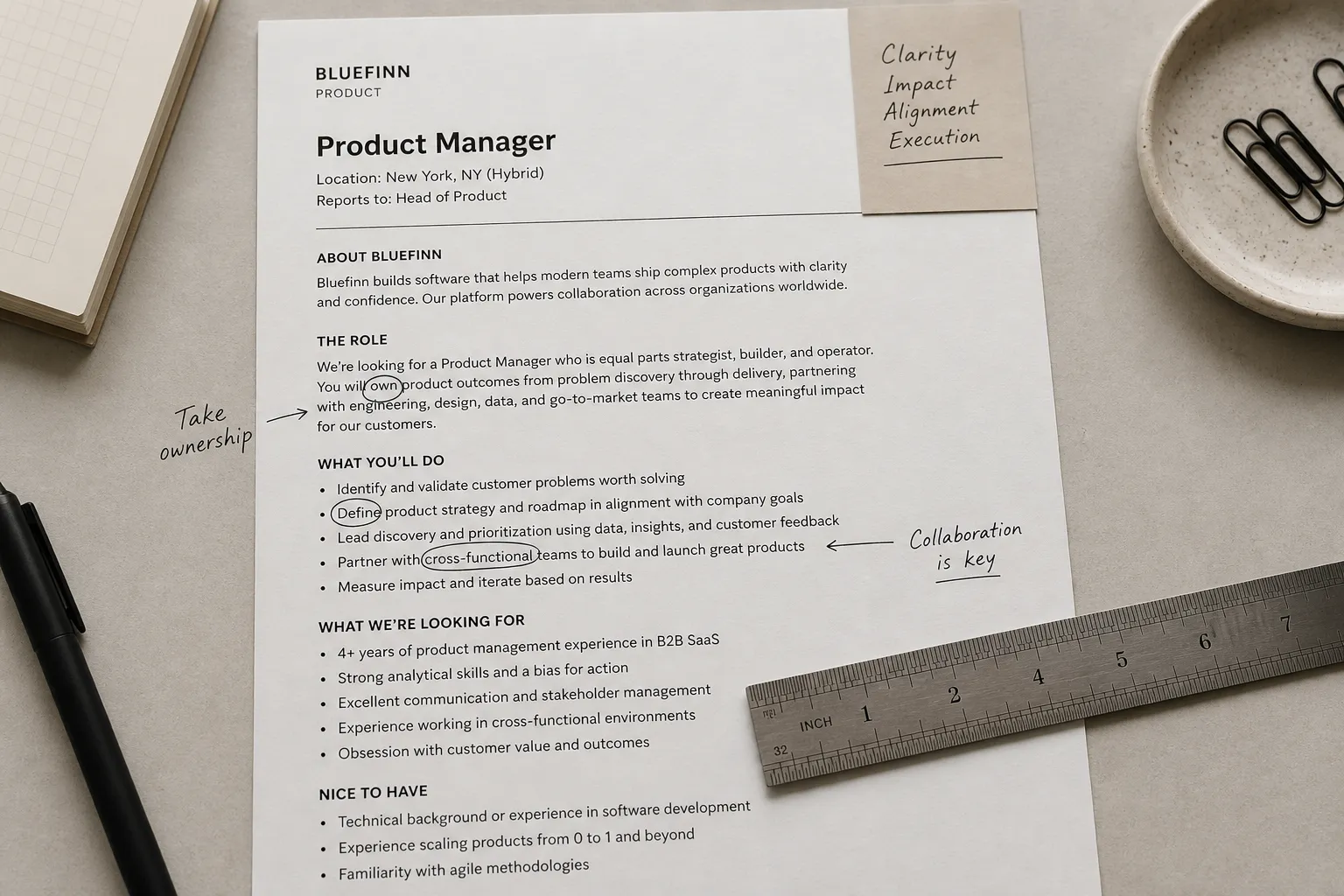
Mid-level requirements use “manage,” “coordinate,” “support,” “execute.” Senior requirements use “own,” “define,” “lead,” “build,” “drive.” If the posting says “manage the roadmap” it’s screening for someone who executes within someone else’s vision. If it says “define the roadmap” it’s screening for someone who sets it. Those are different jobs and they attract different screening signals.
The reporting structure is also more honest than the title. A role reporting to a VP is probably senior. A role reporting to a Director is probably mid. Companies sometimes mislabel based on comp bands or headcount constraints, and the org chart cuts through that noise.
Scope language is the third signal. “Cross-functional” appears in senior postings. “Team” without qualifiers usually means one function. “P&L responsibility” and “org-level” are almost always senior tier.
Read the verb tier, the reporting line, and the scope language. If two of the three read mid, the posting screens mid regardless of what the title says.
The overqualification trap
83% of companies use AI to screen resumes before a human reads them. 50% use AI for initial rejections with no human override.
These systems weren’t built for senior careers. They were built for mid-level roles with standardized keyword requirements. Senior careers are messier. Broader scope. More context-dependent. Less keyword-dense in the way screening models expect.
The failure mode is specific. A candidate with a Director title applying for a senior IC role can get flagged as overqualified before any human sees the application, despite matching every skill requirement. The title triggers the flag. The resume never gets a fair read.
It goes the other way too. A senior-tier posting expects a certain semantic weight in the experience section. A resume written for mid-level roles won’t match it, even if the underlying experience is there.
The title can disqualify you up. The resume can disqualify you down. Both happen automatically, before a person is involved.
What to fix before you send
Pull 10-15 comps before you tailor to one posting.
One posting’s language is noise. The pattern across many similar postings at the same tier is signal. Extract the keywords and verb patterns that appear repeatedly. That’s the vocabulary the screening system has learned for this tier. Build from that list.
Lead with scope, not tasks.
Senior resumes that screen at the senior tier open each role with scope statements. “Led cross-functional product strategy across three business units” lands differently than “Managed the product roadmap.” Both can be true. Only one signals the tier.
Match the verb tier.
Replace “managed,” “supported,” and “assisted” with “owned,” “defined,” and “drove” where the work actually warrants it. Don’t inflate. But don’t understate either. Mid-level verbs on a senior resume train the screening model to read you as mid-level, because that’s the pattern it was built on.
Handle your title if it’s a problem.
If your current title sits several levels above the role you’re targeting, the screening system may auto-flag overqualification. One option: represent the functional scope accurately rather than leading with the title. “Senior Director” at a 50-person company is a different job than “Senior Director” at a 10,000-person org. If your company used non-standard titling, you can describe the scope in a way that’s accurate without triggering a false positive.
Why this matters more right now
Hiring intentions in August 2026 came in at 1,494, the lowest Challenger has recorded. July additions were 44,000, well below the 75,000 expected.
When the market is this constrained, a single miscalibrated tier read has a real cost. The median time from first application to first offer was 108 days in Q1 2026, up 30% from Q4 2025. Most of that time is spent applying to roles the screening system was never going to surface you for.
242 applicants per role on average. Generic applications convert at 2-3%. Tailored applications that match 80-90% of role-specific keywords reach 7-9%+. That gap is entirely a process problem, not an effort problem.
Senior demand is up. Mid-level is shrinking. The candidates who learn to read a posting’s actual tier, and calibrate before they send, are the ones who close in 90 days instead of 200.
The market is giving experienced candidates a real window right now. Most are applying through the wrong one.
Keep reading
More from the RoleNavigator blog